
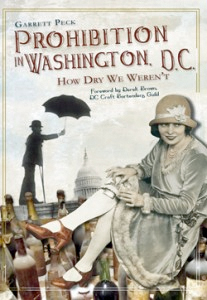
 Washington used to be the wettest dry town in America. Author Garrett Peck tells page-turning tales in his recently-released “Prohibition in Washington, D.C.: How Dry We Weren’t.”
From “Rum Row” to “Temperance Alley,” Peck revives the stories of Prohibition when everybody still drank during the 13 awful years, including presidents. Garrett recently responded to MonumentalThoughts.com’s query on his book.
1. It looks like there were more gin joints around Washington during Prohibition than there are today. How did that happen?
GP: When Prohibition went in effect, manufacturing, selling, and transporting alcohol became illegal, which basically made this an unregulated industry (there were major caveats, of course; there was still “medicinal whiskey” and sacramental wine, and beer brewers made non-alcoholic beer by first brewing regular beer, then using reverse osmosis to removing the alcohol; all of these were open to abuse.). Although saloons were illegal everywhere, consumers still had a strong desire to drink, there was going to be someone who would meet that demand. It’s just economics: supply and demand.
D.C. was peculiar compared to many other major American cities during Prohibition. We didn’t have organized crime (well, unless you count Congress). This meant that the field was open to amateurs, and anyone could get in on the act. Thousands of people bootlegged booze during the era, and there were up to 3,000 speakeasies operating in the city – all illegal, all unlicensed. Before Prohibition, Congress had only allowed 300 alcohol licenses in the city, meaning that there were up to ten times the number of speakeasies as legal saloons!
When Prohibition ended, a major driver was to get the beast back under control, and a key part of that was regulation. Bars would become heavily regulated, and cities could control the number of licenses they issued. You see this fight being carried on today, for example in Dupont Circle, where many residents don’t want any more bars out of fear that it will become another Adams Morgan.
2. Do you think such an underground black market could exist today?
GP: We’ve certainly seen parallels with the drug market(s). The key difference is that most American adults drink, and therefore Prohibition witnessed widespread civil disobedience to the law of the land. Most adults actually don’t take drugs, so it’s easier to marginalize, and we’ve filled our prisons, largely with low-level drug offenders. But we shouldn’t fool ourselves: the war on drugs isn’t winnable.
3. You discuss how politicians and police all drank despite Prohibition. Was it widely known at the time?
GP: Indeed, it was commonly known. A number of contemporary accounts by journalists made it clear that Congress had its own bootleggers, and one senator even remarked that the number of dry senators could fit in one taxi. But it took the courage of George Cassiday, a 10-year bootlegger to Congress, to publicize his story on the front page of the Washington Post in October 1930 shortly before the mid-term election to spill the beans nationally that Congress was far from a dry institution.
4. Washington now has no local breweries, but certainly has regional beers. What do people want to drink when coming to Washington?
GP: DC actually opened its first brewery since 1956 this year: DC Brau. (The last brewery to close was the Christian Heurich Brewing Company, located where the Kennedy Center is now.) It is fascinating to see how large the beer-drinking culture was once in Washington: we had four large breweries to support our locals, and lager was quite popular, given how hot our summers are. But Prohibition ended that culture, and Washingtonians got a taste for cocktails and distilled spirits, as liquor was more profitable for bootleggers to bring to market.
It’s been really fascinating to see how strong the demand for beer is, and I’m proud to see a revival going on. You can hardly stand at ChurchKey since it opened, DC Brau is flying off the shelves, and places like Rustico always seem crowded. There really is a latent demand for beer here – and this in a town that is known for expense account bottles of wine and $12 martinis.
5. If you could return to the 1920s during Prohibition, which tavern would you choose and what would be your drink?
GP: I would have loved to have seen the Mayflower Club, which was busted three times in the waning days of Prohibition. It was a swanky gin joint, and is now the bar Dry Martini on Connecticut Avenue. It would also be great fun to see Bohemian Caverns when it opened during Prohibition – jazz and cocktails always went together. Only today we serve them in a martini glass; back then you would get it in a coffee mug to disguise it.
My drink? Then, as now, the Manhattan.
5A. – I love how the city’s official drink was recently named “The Rickey” but can you get them to spell it right given I don’t use an e in my name and do I get to drink for free?
GP: Ha!
Discover more from Rick Snider's Washington
Subscribe to get the latest posts sent to your email.
